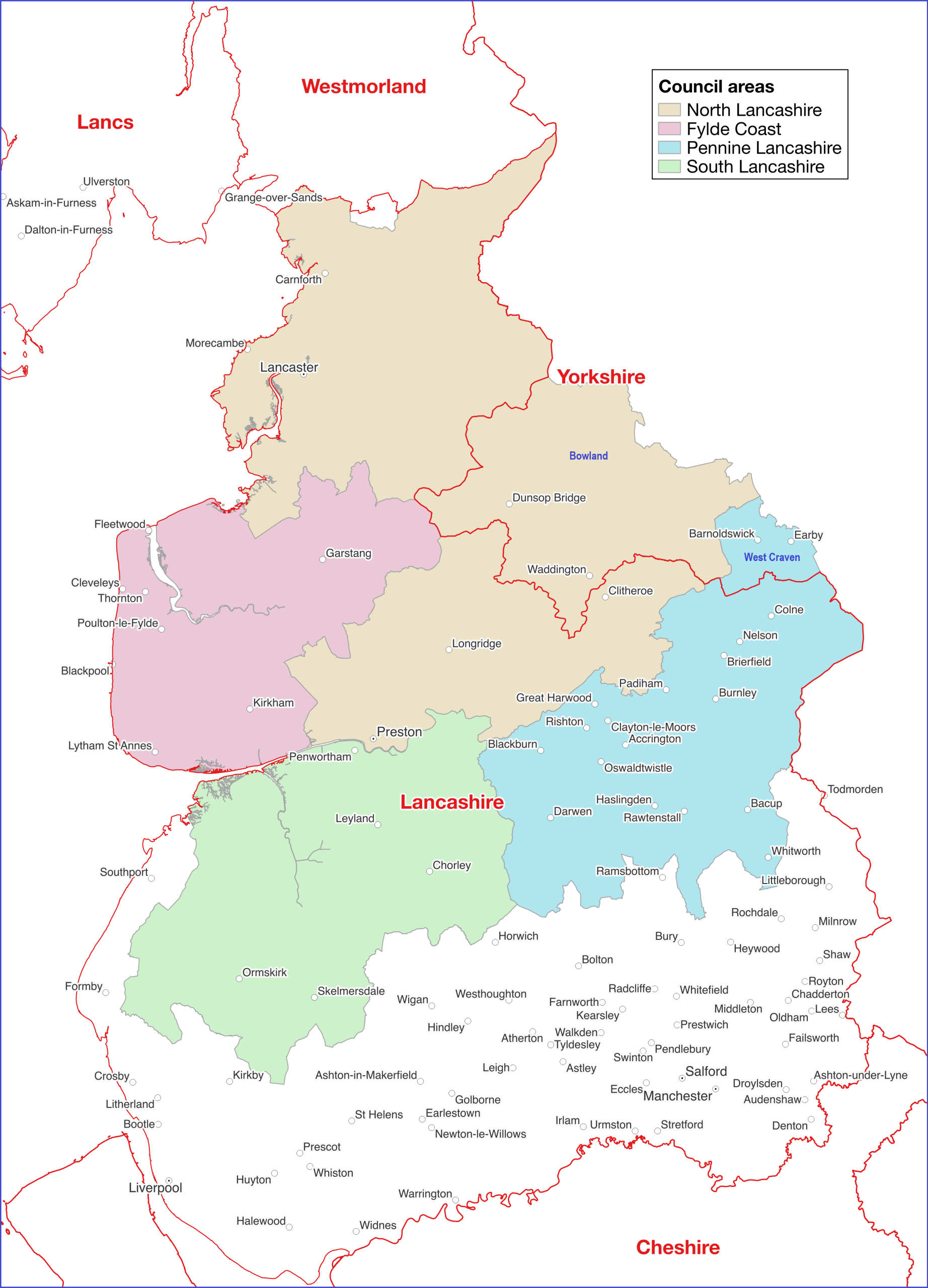
Lancashire County Council, the district councils in its area, Blackburn with Darwen Council and Blackpool Council will all be abolished on 1st April 2028 and replaced by four new unitary councils. The Government is now consulting with the current councils on the names for the new councils. Unfortunately, three of the Government’s proposed council names would undermine traditional county identities. North Lancashire Council and Pennine Lancashire Council would perpetuate the myth that large areas of Yorkshire are somehow literally now in Lancashire. South Lancashire Council does not occupy the south of Lancashire.
Lancashire County Council was one of the worst named of all of the 1974 local authorities. Its area isn’t much like Lancashire at all, excluding the whole urban south of county as well as Lancashire North of the Sands. It infamously includes the Forest of Bowland and West Craven areas of Yorkshire. The existence of this other ‘Lancashire‘ has been a major challenge to those of us who cherish the history, heritage and identity of the real Lancashire – and of Yorkshire too.
The ongoing local government reorganisation provides a golden opportunity to right this wrong. The names of each new unitary council must be chosen so as to properly reflect the location of that council’s area within Lancashire itself and, where relevant, to give proper respect to the Bowland and West Craven areas of Yorkshire.
This local government reorganisation will certainly be a big step forward in that the new unitary councils will be called just “council” and not “county council”. None of the new councils will literally make claim to be Lancashire itself.
Nonetheless, the proposed council names North Lancashire Council, Pennine Lancashire Council and South Lancashire Council do not describe the location and area of these councils compared to the real Lancashire and Yorkshire and would continue the confusion of the last 54 years. Below we suggest alternative names for each of these three councils.
We are asking the Government and the current councils to consider these alternatives or to find their own – so long as the final names do not mispresent our counties. Make sure you let your local councillor and your MP know your views asap.
The councils have until 17th August to respond to the proposed names. The same consultation process and deadline applies to the other local government changes we discussed in Reclaiming our counties: the end of “county councils”.
North Lancashire Council
This new council area is a combination of the current districts of Preston, Lancaster and Ribble Valley.
The Ribble Valley district, created in 1974, incorporated the whole of the former Bowland Rural District, the area of which lies entirely within the West Riding of Yorkshire.
Around 110 square miles (22%) of the new council’s area lies in Yorkshire, including most of the famous Forest of Bowland. To call this council just North Lancashire Council would be both absurd and outrageous. Better names include:
- Preston, Lancaster and Ribble Valley Council – a county-neutral name which highlights the civic identities of Preston and Lancaster but without portraying the whole of this area as being in Lancashire;
- North Lancashire and Bowland Council – a simple way to reflect the fact that much of this areas lies in the northern part of the main body of Lancashire but that a large part of it comprises the Forest of Bowland in the West Riding of Yorkshire.
We would be delighted to hear alternative suggestions for names for this and the other councils.
Pennine Lancashire Council
This new council area is a combination of the current districts of Burnley, Hyndburn, Pendle and Rossendale along with the current unitary council of Blackburn with Darwen.
The West Craven area of the West Riding of Yorkshire was made part of Pendle Borough Council area in 1974, the area having previously being part of Skipton Rural District. The Yorkshire identity in the towns and villages of West Craven – Barnoldswick, Earby, Kelbrook, and Salterforth – remains strong.
To call the new council Pennine Lancashire Council perpetuates the myth that the whole of this council area is part of Lancashire. Better names include:
- Pennine Lancashire and West Craven Council – this very explicitly makes clear that West Craven is not part of Lancashire;
- East Lancashire and West Craven Council – a more geographically accurate alternative;
- South Pennines Council – a county-neutral name which retains the association of the new council area with the Pennines.
South Lancashire Council
This new council is a combination of the current districts of West Lancashire, Chorley and South Ribble.
Whilst the new council area lies entirely within Lancashire, the adjective ‘South‘ is wholly wrong for the location and extent of the area within the historic county. This is not in any sense the ‘southern strip’ of Lancashire. Better names include:
- West Lancashire Council – simple and geographically accurate;
- Central Lancashire Council – this name was suggested for this self same area in one of the other submissions to the local government consultation;
- Heart of Lancashire Council – an alternative approach to reflecting the council area’s place in the centre of Lancashire.
Fylde Coast Council
This new council is a combination of the current districts of Fylde, Wyre and the current unitary council of Blackpool.
ABC has no issue with the name of this council. Adopting a county-neutral name of this type would be a wise move in the other three council areas.
Implementing the new council names
The existing councils have been asked to respond to the proposed names by 17th August 2026. Once the Government has made a final decision on the names then the creation of the new councils will be implemented via a Statutory Instrument. Shadow authorities will be elected in May 2027. Ultimately each new council will be able to amend its name from that given in the original Statutory Instrument.
Lieutenancy and Combined Authority
As far as we are aware, the local government changes will have no affect on the “Lancashire” lieutenancy. To leave the lieutenancy based on the former Lancashire County Council area would be anachronistic and absurd. ABC has proposed that the lieutenancies throughout the UK be re-appointed to the historic counties.
The so-called Lancashire County Combined Authority will continue after the local government changes, still covering an area which isn’t anything like Lancashire. The only positive is that at least the word “County” will disappear and it will be called the Lancashire Combined Authority. This combined authority also needs to choose a more sensible name.
Concluding Remarks
Most of the new unitary council names throughout the rest of England will not contradict and challenge historic county identities. These councils replacing Lancashire CC are something of a rare case where the unitary councils could end up with names which confound traditional geography. All the more reason to do all we can to ensure that geographical sanity prevails.
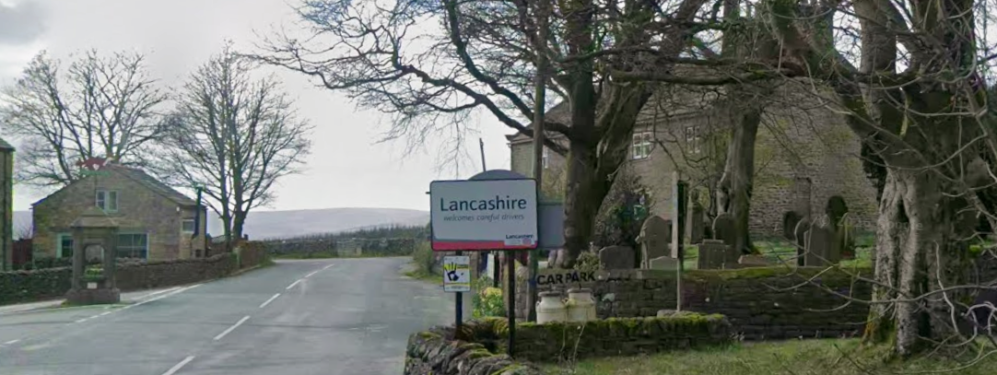
Banner image of ‘Lancashire welcomes careful drivers’ sign in Tosside, Yorkshire is courtesy of Google Maps.