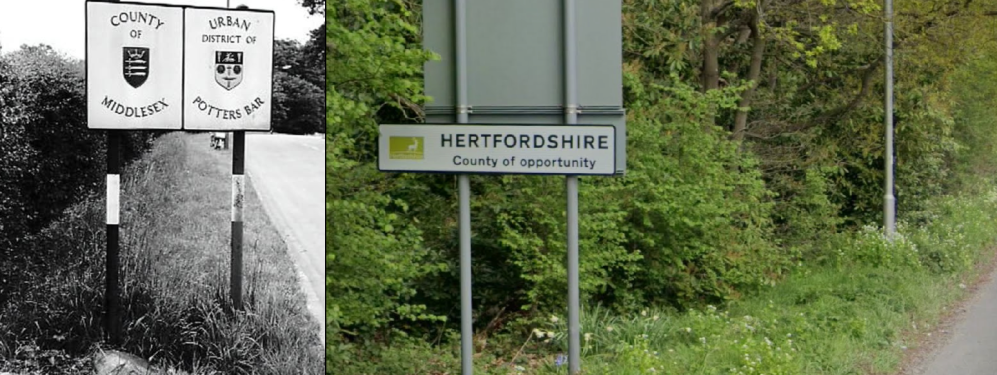
Since 1965, the Middlesex identity of Potters Bar has been grievously eroded by its placement under the misleadingly named Hertfordshire County Council. The abolition of this local authority in April 2028 and its replacement by four unitary councils could herald a new era in which local government can be properly seen to be totally separate from the counties – as the Government has consistently stated since local government was first created in 1889. The fact that Potters Bar and Borehamwood lie in different counties but the same council area need cause no confusion or loss of traditional county identities, so long as that council’s name is chosen appropriately.
The provisional name ‘South West Hertfordshire Council‘ most definitely is not appropriate for the new council area that includes Watford, Borehamwood and Rickmansworth in Hertfordshire but also Potters Bar and South Mimms in Middlesex . Alternative names such as ‘Colne Valley Council’, ‘Watford and Colne Valley Council‘ or ‘Watford and Hertsmere Council‘ could represent the whole of this new council area without mispresenting historic county identities.
Potters Bar: a case study in “county confusion”
Potters Bar provides a case study in how the use of the word “county” within local government terminology since 1888 and the ‘borrowing’ of county names by local authorities has, over time, had devastating consequences for traditional county geography, loyalty and identity in many parts of Great Britain.
The northern tip of Middlesex has born the name ‘Mimms’ since before the Conquest, with ‘South Mimms’ being the documented parish name since at least 1253. Middlesex County Council was first established in 1889 by the Local Government Act 1888. South Mimms parish became the basis of South Mimms Rural District under Middlesex County Council in 1895. This was renamed Potters Bar Urban District in 1934 as the former hamlet of Potters Bar grew into a busy suburban town.
The London Government Act 1963 abolished Middlesex County Council and placed Potters Bar Urban District under Hertfordshire County Council from April 1965. The Post Office insisted that Potters Bar residents include ‘Hertfordshire‘ in their postal address. The Post Office made no such change elsewhere in Middlesex, for example in the Spelthorne area which found itself under Surrey County Council but remained postally Middlesex, thereby preserving the Middlesex identity of the people of Ashford, Staines and Sunbury. Hertfordshire County Council erected road signs proclaiming Potters Bar to now be part of Hertfordshire, signs which are geographically inaccurate as it is the administrative county that they are referring to and NOT the true geographical county.
The Local Government Act 1972 abolished Potters Bar Urban District and, from April 1974, placed the whole area within a new larger district of Hertsmere, still under Hertfordshire County Council. Around three-quarters of Hertsmere district lies in Hertfordshire (including Borehamwood, Radlett and Bushy) and one-quarter in Middlesex (including Potters Bar, South Mimms and the southern part of Elstree). The name ‘Hertsmere‘ was chosen to reflect this cross border nature – the ‘mere‘ (boundary) being both a reference to the area straddling the county border and also to Oakmere House and Park in Potters Bar.
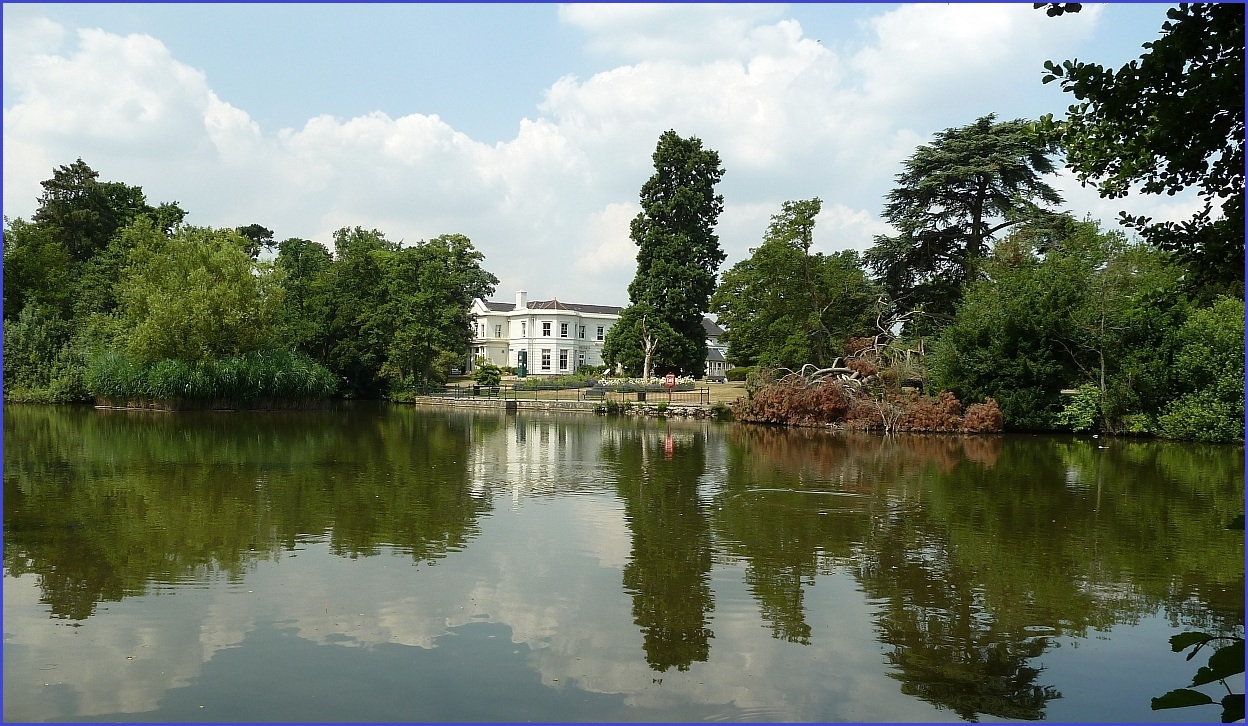
None of these local government changes affected the real counties at all, of course. But the continued misuse of the word ‘county‘ to describe local authority areas and the name Hertfordshire County Council to describe one such area which isn’t Hertfordshire at all has led to an egregious assault on the Middlesex identity of the Potters Bar and South Mimms area.
The ongoing local government reorganisation provides a golden opportunity to right this major historic wrong and to once and for all get away from the whole notion that local authorities are in any way related to the counties – the root cause of this and so many other “county confusion” problems throughout Great Britain.
1st April 2028 – the End of Hertfordshire County Council
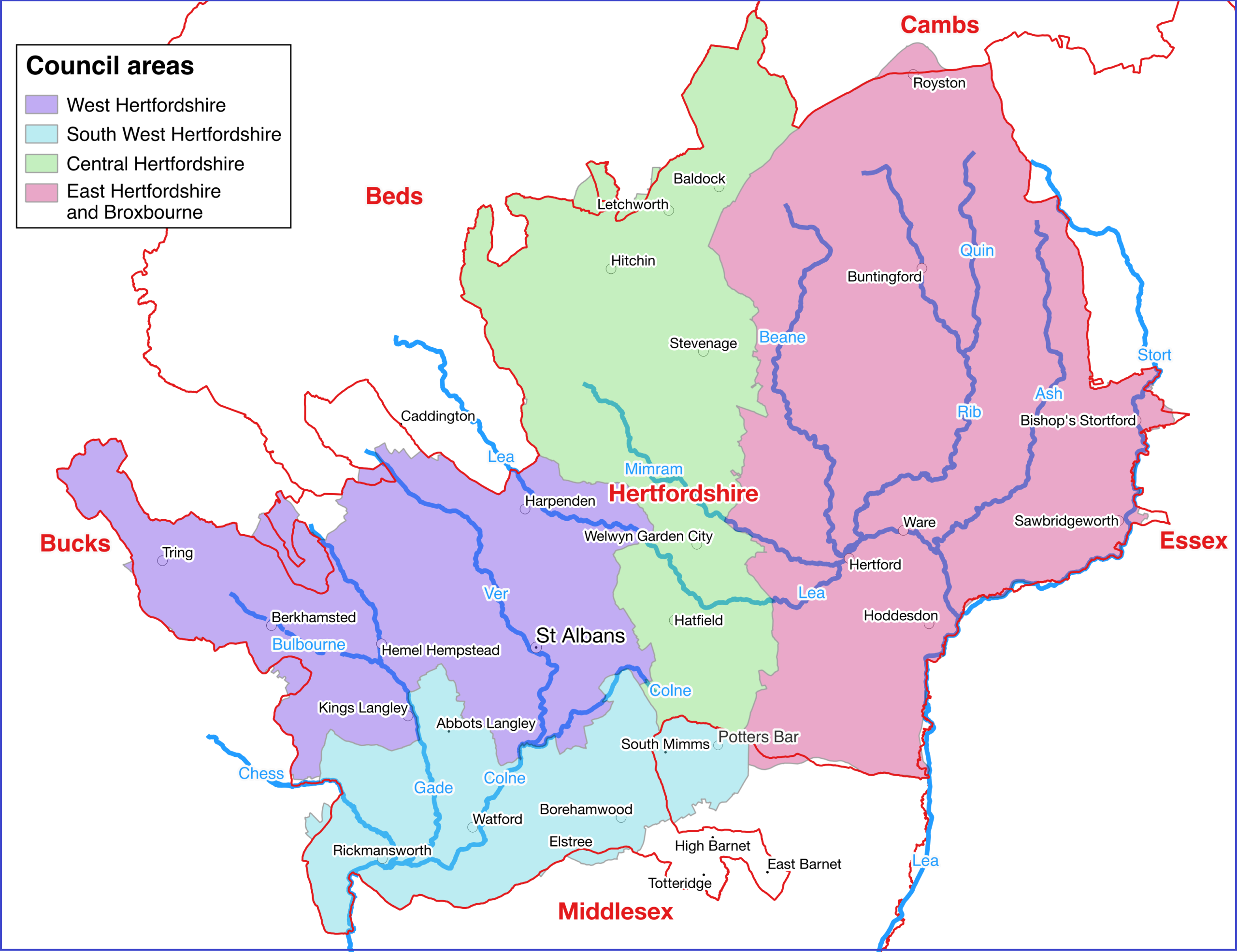
On 1st April 2028, the local government “county” of “Hertfordshire” will be abolished, as will Hertfordshire County Council and the 10 district councils in its area. They will be replaced by four new unitary councils. The map shows these unitary council areas, along with the provisional names by which they are currently being referred.
The Association of British Counties (ABC) wants to see an end to the use of the terms “county” and “county council” in local government terminology and parlance and an end to the misuse of county names by local authorities. These changes are a significant step forward in that:
- the new unitary councils will be called just “council” and not “county council”;
- there will no longer be a local authority which is literally claiming to be Hertfordshire itself.
On the other hand, the four new unitary councils are being created by dividing the current (though soon to be abolished) local government “county” of “Hertfordshire“. The use of ‘Hertfordshire‘ within each of the provisional names reflects this and risks perpetuating the misconception that their combined area literally is Hertfordshire. This will be reinforced if, as seems likely, the combined area of these four councils becomes the new definition of the so-called “ceremonial county” of “Hertfordshire” (see below).
Three of the new council areas do at least more or less lie within the borders of the real Hertfordshire. Not so the provisionally-named South West Hertfordshire Council which includes Potters Bar and South Mimms.
It is vital that the new councils adopt names that altogether avoid giving the impression that they are divisions of the former local government “Hertfordshire“. If they must use the name ‘Hertfordshire‘ at all then it should be done with appropriate qualification which makes sense in relation to the real Hertfordshire. It may be wise, especially for the provisionally-named South West Hertfordshire Council, to avoid using ‘Hertfordshire‘ at all.
The existing councils have until 17th August to propose alternatives to the provisional names. The Government will then make a decision on a name for each new council to put into the Structural Change Order – the legislation which will enact the local government changes.
The final decision on a council’s name will rest with the shadow council once elected in May 2027. Each will be able to change its name from that given in the legislation, as the shadow council now named West Surrey and South Middlesex Council (elected in May 2026) has recently done.
South West Hertfordshire Council
This council is being formed from the areas of the three current district councils: Watford, Three Rivers and Hertsmere.
ABC considers the provisional name South West Hertfordshire Council to be wholly inappropriate. Whilst a majority of the council area does lie in the south west of Hertfordshire (i.e. the real county), three significant parts of the council area are not in Hertfordshire at all:
- Ten square miles in the east of the council area lies in Middlesex. This area includes the town of Potters Bar, the village of South Mimms and the nearby South Mimms motorway services. This area comprises about 12% of the council area and 8% of its population (around 25,000).
- The council area also includes the southern part of the village of Elstree (the larger part of the village) which lies in Middlesex.
- A small area of Buckinghamshire lies in the west of the council area, including Chorleywood West.
The new council area does not include the highly populated Barnet salient of Hertfordshire.
Forming a compound name from the two counties – as has been done with ‘West Surrey and South Middlesex Council’ – is challenging for this area. A county-neutral name may be better.
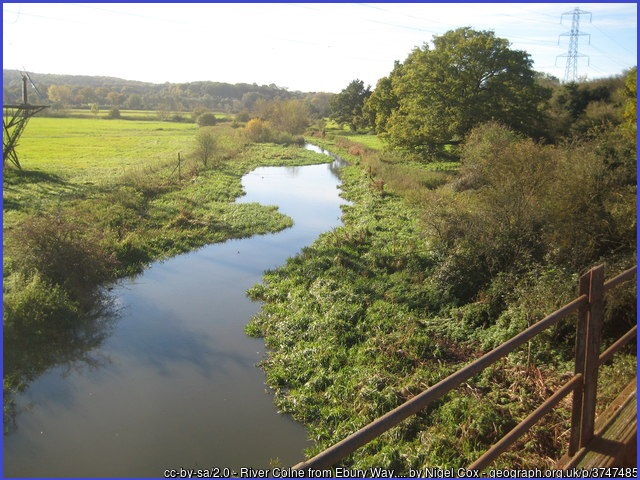
We suggest that Colne Valley Council could represent the whole council area without giving precedence to any current council or town names and without mispresenting historic county identities. The River Colne binds this region together. It rises at North Mymms, being fed by the Mimmshall Brook which rises near Borehamwood and flows north between Potters Bar and South Mimms. The Colne then flows along the boundary of the eastern part of new council area and then down through the centre of the council area and on through Watford and Rickmansworth.
Another approach would be to base the new council’s name around Watford, the main town in its area. Watford and Colne Valley Council combines this with the above suggested name. Alternatively, Watford and Hertsmere Council would have the advantage of retaining the ‘mere’ part of Hertsmere, a reference to the cross border nature of this area.
We have no strong objection to alternative council names along these lines, so long as the final name does not continue the 1965 mistake of portraying Potters Bar as literally being in Hertfordshire, which it is not and never has been.
East Hertfordshire and Broxbourne Council
This council is being formed from the areas of the current East Hertfordshire and Broxbourne districts, along with small areas from the North Hertfordshire and Welwyn Hatfield districts.
The provisional name does at least reflect the fact that most of its area lies in the east of Hertfordshire (i.e. the real county), although the larger part of Royston lies in Cambridgeshire. A compound name of this form also helps public understanding of the purely administrative nature of a council.
Central Hertfordshire Council
This council is being formed from the areas of the current Stevenage district and most of the districts of North Hertfordshire and Welwyn Hatfield.
The provisional name Central Hertfordshire Council does at least reflect the fact that almost of all of this council area lies in Hertfordshire, bar a few very small rural areas of Bedfordshire in its far north. Basing a council name around one or more of the main towns would be challenging since Stevenage, Welwyn Hatfield, Hitchen, Hatfied and Letchworth would all have a claim to be included. An alternative name would be Mimram Council, based on the chalk stream that runs through the heart of this area into the River Lea at Hertford.
West Hertfordshire Council
This council is being formed from the areas of the current districts of Dacorum and St Albans.
The provisional name West Hertfordshire Council does at least reflect the fact that almost of all of this council area lies in the west of Hertfordshire, bar a small area of Buckinghamshire around Great Gaddesden and a very small area of Bedfordshire around Markyate. Alternative names could be based around the main towns St Albans and Hemel Hempstead. More creatively, a council name could be formed from the main rivers of the area, e.g. Gade and Ver Council.
A Lord Lieutenant of Middlesex?
ABC has long argued that the lieutenancies throughout Great Britain should be dissociated from local government altogether and the lord-lieutenants appointed directly to the historic counties – see The lieutenancies of England and their relationship to the historic counties. Such a move would provide Government recognition of the importance of both the historic counties and these offices.
In England the ‘counties for the purposes of the lieutenancies‘ of the Lieutenancies Act 1997 – the so-called ‘ceremonial counties‘ – remain defined in terms on local government areas, in most cases still reflecting the 1965/1974 local government areas. The present large-scale local government reorganisation is a perfect opportunity to return all the lieutenancies to the historic counties. To leave them appointed to a group of short-lived, now former local government areas would be absurd.
At present, the Government appears to not want to make any amendments to lieutenancy areas unless its local government changes force such a change upon it. Which suggests that it intends to keep the Hertfordshire lieutenancy as it is, although the Lieutenancies Act 1997 would need to be amended to define the lieutenancy area in terms of the four unitary councils, since the local government “county” is being abolished. This will inevitably lead to the misconception that the four new unitary councils are divisions of the “ceremonial county” of “Hertfordshire“ – although the relationship would actually be the other way around.
The Lord Lieutenant of Hertfordshire and his deputy lieutenants no doubt provide excellent service to the people of their area. Nonetheless, if the Government wishes to continue to use historic county names for the titles of the lord-lieutenants then it should appoint this office directly to the real counties. If not, it should stop aping real county names and it should stop referring to these areas as “counties” within the Lieutenancies Act 1997.
Interestingly, the Government has suggested that it may agree to create a separate lieutenancy for Rutland despite the fact that Rutland County Council is to be abolished. If Rutland is no longer the basis of a local government area but can have its own lord-lieutenant, then why cannot Middlesex? Why cannot every historic county in Great Britain?
Concluding Remarks – a return to geographical sanity
ABC promotes the geographical and cultural identities of our historic counties. We emphasise that the counties are distinct entities to any form of present-day administrative area. There is no reason why administrative areas cannot cross county borders, provided that the administrative terminology and the administrative area names are chosen so as to make clear the difference.
From 1835-1930, South Mimms, Monken Hadley and Friern Barnet were all part of the Barnet Poor Law Union. No one ever believed or suggested that these areas were no longer in Middlesex and were now part of Hertfordshire. It was always clearly understood that Poor Law Unions existed for the purpose of administering the poor law and not for anything else. No confusion was created and no identity problem caused.
Similarly, South Mimms and Potters Bar – along with several Hertfordshire parishes – were part of the Metropolitan Police District from its creation in 1829 until 2000. And yet nobody who lived in these places for one moment believed that, because they were policed by the Metropolitan Police, those places could no longer be in Middlesex or Hertfordshire.
When police areas were aligned with local government areas in 2000 and the Potters Bar area put under an enlarged Hertfordshire police area, this was an administrative area change which, as with local government changes, made no difference to the actual counties of Middlesex and Hertfordshire.
The people who decide these matters, whether in Parliament or at the local council level, should understand once and for all that the historical and geographical areas of our counties are entirely different to, and totally separate from, administrative areas. People cannot be expected to change their postal addresses, relearn the geography of our country and adopt a whole different sense of identity and community every time there is change in the administrative areas of one public service or another.
Local government administrative areas are just that – solely for the administration of local government and not for any wider geographical or cultural purpose. The new councils replacing Hertfordshire County Council must choose names that reflect this fact.
One thought on “Why ‘South West Hertfordshire’ fails Potters Bar”
Good article! Makes your position and reasoning clear. Down with county confusion!